Security Team Workflow (Recommended)
Boundary: FroggerAPI does not run scans, manage credentials, or interact with Tenable APIs. It enforces OpenAPI specifications before scanning.
FroggerAPI is designed as a security-owned handoff between development and security. Developers describe their APIs. Frogger validates and normalizes them. Security feeds Tenable WAS with confidence.
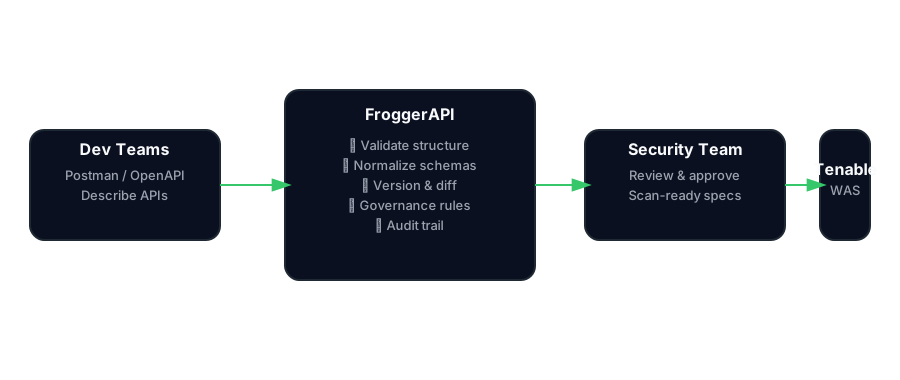
The canonical flow
Dev Teams
  ↓
FroggerAPI (validate + normalize + version)
  ↓
Security Team
  ↓
Tenable WAS
This workflow avoids blocking deployments while ensuring Tenable scans are driven by accurate, current API definitions.
Step 1 — Developers submit API definitions
- Developers upload Postman collections or OpenAPI files to FroggerAPI
- No Tenable access required for dev teams
- Submissions can be manual, scripted, or CI-assisted
Frogger does not deploy code and does not control CI/CD by default.
Step 2 — Frogger validates & normalizes
- Structural validation (OpenAPI correctness)
- Schema tightening (types, bounds, patterns)
- Deterministic normalization (no AI / no guessing)
- Versioned history with diffs
- Audit trail for governance decisions
Invalid or incomplete specs are flagged early so security never scans with bad inputs.
Step 3 — Security reviews & selects
- Security teams review the latest validated spec
- Diffs show exactly what changed since last scan
- Audit logs show who submitted what and when
Frogger becomes the system of record for “scan-ready” API definitions.
Step 4 — Security feeds Tenable WAS
- Validated OpenAPI is imported into Tenable WAS
- Scan coverage improves
- False positives from permissive schemas are reduced
Security scans what actually exists — not outdated or hand-edited specs.
Where CI/CD fits (optional)
CI integration is optional. Some teams run Frogger checks in CI for early visibility, but Frogger does not need to block deployments to be effective.
See the CI integration guide if you want to add non-blocking or gated checks.
Who owns what
| Role | Responsibility |
|---|---|
| Developers | Describe APIs accurately (Postman / OpenAPI) |
| FroggerAPI | Validate, normalize, version, audit |
| Security | Select scan-ready specs and configure Tenable |